
The Problem with Cities (especially Manchester)
TLDR; they don’t have enough hidden, quiet, private places
-
The booklet for planning nerds
There’s no place I want to love more than Manchester. I’ve been and gone there hundreds, maybe a thousand times all my life. It is:
Historic with Roman ties
Distinct in architectural character
Post-industrial
Well-located
Actually has an economy
Has a scientific background
And critically, it is not London
Yet the more I go, the more I dislike it. It essentially boils down to one thing. There’s nowhere to hide. Which means there’s nowhere to simply be. It’s becoming very common in British cities. I’m using Manchester as a familiar example which I care about. Allow me to elaborate from a good place.
Open design is a closed doctrine
There is an unspoken orthodoxy in urban planning, architecture and even our social fabric itself. That people always want to be together. That we want to be in each other’s space and proximity all the time, all day, every day. It is inescapable:
Open lobbies in hotels, malls, entrances, etc
Open-plan restaurants and pubs
Open kitchens
Open squares
Open parks
Open office spaces
There seems to be an implicit belief that good design is ‘open’ design. That people always want to be around each other, see each other, hear each other and feel ‘a buzz.’ I beg to differ. Good design is multi-faceted and balanced. It balances public and private. Built and natural. Light areas and dark areas. Yet so many modern layouts are open to the point of constant stimulation and irritation. Manchester is an especially bad culprit for this. There are very few quiet, very few meditative places in central Manchester.
Whilst beautiful, John Ryland’s is drowning to the eyeballs in tourists.
Whilst grandiose, the round library is one enormous echo chamber (literally.)
Whilst famous, Piccadilly Gardens is a concrete, drug-laden wasteland.

Ryland’s library was designed to be a meditative, quiet place of knowledge, but functions more like a stopgap on a bus tour. No matter where you go in Manchester, there are always people. Always. Taking photos. Eating smelly food. Blocking your way. Talking. Gossiping. Shouting. Raving. Literally raving – playing music topless whilst raving in a public square. And people go along quietly out of ‘politeness’ and ‘tolerance.’ It isn’t only the fallen condition of man. I also blame architects, planners and developers for nearly always opting to make every space as high-intensity and aimlessly open as possible. There’s little flair, balance nor humaneness; only an induced imposition of space. Designing spaces as if people live like ants.
Dead green spaces
The ‘green’ spaces in many cities are well-intentioned, but often the size of a sub-urban garden. They often lack landscaping, shielding, flowers or any biodiversity. They’re performative rather than being truly alive. Birds won’t nest in them. Flowers won’t bloom on them. Fruit won’t fall off them. A tree is always better than no tree, yet I keep feeling the ‘fakeness’ of Manchester’s urban landscaping. The few trees that are planted are for ‘aesthetic’ qualities rather than softening light, muffling sound, increasing privacy or improving biodiversity. There’s also an incoherence to green space and garden layouts. Formal planting in informal spaces. Monoculture. Over-cutting. High-maintenance schemes. Scorched grass areas. And so on.

The real jewels of Manchester’s greenery tend to be from normal people. Not from ‘social programs’ or ‘GMCA investment.’

The institutionalisation of subculture
Manchester is a good place for subcultures to emerge. It’s located like the heart of a spider’s web in the north of England. It also sits on the Irwell. It helped give birth to:
The Industrial Revolution
The modern police force
One-Nation Conservatism
Association football
The computer
Gaylib
Punk
Acid house
Something all these ideologies, inventions and ideas share in common is that they are inductive. They are ‘bottom-up’ or ‘grassroots.’ They are products of normal people doing things. They are not ideas deduced from government, academics, experts, sages nor corporations. Yet whenever one visits Manchester, everywhere, on every building, every business, every corporation, every street corner has words and banners like:
INDEPENDENT
AUTHENTIC
CONCEPTUAL
PRIDE
VIBRANT
It starts to appear dependent, inauthentic and banal. Even Andy Burnham, the mayor and maybe soon-to-be prime minister desperately depicts himself a ‘man of the people’ - in Blair’s parlance ‘a normal sort of guy.’ There’s little more woeful, tiresome and cringey than bureaucrats and businessmen pretending to be ‘one of us.’ Manchester (and many English cities) are soaked with inauthenticity parading as authenticity. Corporations pretending to care. Chaos pretending to be culture. Developers pretending to invest. It isn’t just visual - it’s psychological and increasingly pathological. The moment a city becomes too overtly aware of itself, it becomes an image of itself. It loses its own origin.
Old and new becoming old
Manchester, along with other cities, are VERY keen to show they’re economically active. Two key words (or buzzwords) are investment and development. And these are two very good things. Places need interest, care, time, money and capital. A civilisation that doesn’t maintain itself dies. But development is a double edged sword. One that can cut its holder.
Many places have developer money thrown at them. It’s often well-intentioned. But it doesn’t mean it’s good for the place or city more generally. It leads to some of the issues with Manchester, London and other places. Over-extraction of any given plot. Jarring skyscrapers looming over rotten warehouses next to a medieval church. It also leads to a weird feeling of incoherence rather than ordered variety. And even worse, it leads to what I call ‘spatial disrespect’ in architecture.
‘Neophilia’ is a term from historian and academic Dr David Starkey, meaning ‘attraction to new.’ He contends neophilia almost as bad as paedophilia. On increased reflection, I’m inclined to agree. The ‘new’ can be as vapid, hollow, extractive or destructive as it comes, but simply because it’s ‘new’, many are inclined towards it. Simply because it’s glossy and shiny. This concept doesn’t mean all new things are bad – quite the opposite. The danger is the instinct within people to like the new at all costs. The tendency for businesses, developers and politicians to present anything new as better. And sadly, Manchester (and especially the skyline of London) have suffered for it.

Spatial disrespect is the sense that a brand new glass box shoved right next to a 19th century bank building isn’t ‘dynamic’ and ‘investment in the city.’ It often feels, rightly or wrongly, disrespectful, jarring, inserted, imposed and desperately attention-seeking. It’s ‘neophilic.’ The notion of ‘old with new’ is a very noble one, and some places do it well. But in my humble opinion, the UK often fails at this. And the propaganda of the modern metasystem, telling us that all ‘new’ things are good is simply not true. It’s become waring. It’s become hollow. The idea of ‘old and new’ is becoming old – not as an idea, but in its execution.
Noise
Noise is the environmental challenge of the 21st century. I care more about noise than carbon emissions or microplastics. Noise can ruin lives. Pervasively, slowly, cruelly and persistently over many years. It raises heart pressure, it raises cortisol, it disturbs sleep and yes, it can shorten lives. Yet so so so few places ever design for noise suppression in mind at all. I’ve already mentioned open spaces. But it’s much more pervasive.
Noise is part of human life. Most accept that. But so many places in urban areas end up being:
Echo chambers (metaphorically too, but another matter)
Acoustically harsh (shopping malls, food courts, bus stations, etc)
Poorly planned (playgrounds right next to food places for example)
What I call noise stacks – endless stories without enough soundproofing, insulation, tight fittings, etc)
And to compound the problem, very few urban areas have ‘auditory retreats.’ Places to hide. Places to turn off for 5 minutes. Nooks. Corridors. Lobbies. Squares. Shelters. Retreats. There are not many ‘semi-private’ places. Places that exist without selling you something, nor there to stimulate your senses, but exists merely because you’re a human being with human needs. And over time, as the city becomes busier, more active, more populated and more ‘developed’, it loses those humanising jewels of everyday life. Which leads to the next point.
Everything for a reason for no reason at all
Too many cities have places that exist for a reason. It can be any reason. No matter how banal. Spaces that exist to sell you stuff. Tempt you with food. Overwhelm your senses. Travel somewhere. Experience something
But after a while, the more you experience these spaces, the more waring they become. They become numbing in the strangest way. They’re not just overwhelming, but they become flattening. They flatten the human being into a hyper-social, extractable, manipulable piggy box to extract as much from. People need more than mere novelty and excitement. They also need familiarity and containment. A good city or town should have both:
Areas of hub-bub and areas of quiet
Commercial areas and recreational areas
Areas with skyscrapers and more human-scaled areas
Denser areas with more open areas
Older areas with newer areas
Manchester struggles with that balance. Manchester tends to lean too much towards the left hand side of that list. A better city is more balanced. More structured. Both more deliberate, with some indeliberate spaces – those aforementioned spaces that make life bearable and human. One could say cities need to be ‘deliberately indeliberate.’ Cities are much closer to organisms than algorithms. Yet many cities are leaning towards that algorithmic model. Even the language planners and politicians use is revealing:
Footfall
Turnover
Units
Spacing
Numbers
The result is many cities are very good at high-intensity public spaces, but really bad at lower-intensity spaces. Which ironically would lead to even more traffic in higher-intensity spaces, but that’s another matter.
Some better, realistic ideas
I loathe to merely critique and complain without any solutions. So here are some ideas of my own, from other people and other places that do things a little bit better than my dear Manchester.
Poor planning (system)
I am unconvinced in the efficacy of the planning system in Britain. The planning system’s shortcomings are a book in length. However, one of the paradoxes of the planning system is the more legislation is passed, the worse the results become. The more oversight there seems to be, the more checkboxes there are, the uglier and poorer the developments are… why?
I propose it’s because the planning system analyses and incentivises the wrong things. Instead of coherence, beauty, necessity, ‘fit’, weighing things up honestly and locally set planning targets, we have a system that analyses:
Investment levels
Volume increase
Biodiversity net gains
Employment numbers
Matching central government targets
It is one of the reasons property development here is so slow, incoherent, expensive and sometimes staggeringly ugly. When discretion and judgement are replaced with boxes to be ticked, the incentives of decent people can become very skewed. Instead of building something beautiful, it becomes better to build something cheap. Instead of repurposing an old building, it’s more viable to build a tall new one. The result is the ‘broken teeth’ skyline of somewhere like London and increasingly Manchester.
Return of the cloister
The medieval world is often laughed and sneered at. Sometimes for good reason. But often not. The Middle Ages produced some of the most awe-inspiring architecture the world has ever seen. Medieval architectural engineering knocks classical architecture a cocked hat. Leave the abbeys and cathedrals of that world aside. Even domestic architecture has its own logic. It’s well-spaced, practical, elegant and vernacular. And more than anything, it’s humane.
And institutional buildings from the age - guild halls, markets, churches and even Parliament itself often had a cloister. It was a semi-open and semi-private square where people would walk to catch their breath from the business of living an adult life. They’d ‘do a lap’ to reset their own nervous system. Some were small and spartan, and others were gilded with carvings, recesses and gardens. Whilst some would sneer at ‘wasted space’ like this, I don’t. People need that contrast of space in life. From the busy to the still. From the loud to the quiet.

The return of cloisters and its older Greek cousin the Stoa (almost like a cloister up against a wall) would do so much good to British urban spaces. Places would become sheltered. People would want to visit and stay longer (which is good for business, especially hospitality.) Ever notice how exposed, uncovered, open and concreted so many public spaces are? In this country that’s windy and cold? That’s the price of building works that prioritise the wrong values. Footfall, unit capacity and advertising capability over crowd flow and shop + services quality.

Genuine green breaks and blocks
Horticulture is something I’m passionate about. Genuine plant and animal life in urban environments is the future of cities. Yet sadly, too many ‘green’ areas, breaks and parks are performative, monocultural or sometimes simply box-ticking. Greenwashing is quite a good term - pretending to be greener than you are to get brownie points. It is an all-too-common reality of modern life sadly.
There are better and different ways though. Biodiversity, flora and life doesn’t require huge allotment areas, lakes or parks (though those are necessary in balance with a good city.) Rather, something as simple as leaving verges to grow naturally. Planting grasses, ferns and wildflowers under urban trees. Leaving a 30cm wide strip of exposed earth next to a skyscraper to allow wildflowers to slowly flourish. The sky is the limit when you realise that the greenest cities start growing in the smallest of places. It’s not the planners or experts who inculcate this, but the ordinary citizen who sees and cares.

Acoustics – design for the ear, not just the eye
Too many public spaces (and increasingly homes) are designed with ‘the eye over the ear.’ Meaning they value how they look more than how they sound. I’ve ranted enough in the first half about this. But some solutions to the scourge of sound are really quite simple.Cloisters, corridors and green spaces all help. What are dubbed ‘transitional spaces’ also help. Small lobbies, door overhangs, backrooms, etc. But I also think there should be such a thing as ‘acoustic zones.’ Places you can escape from sound, noise, hubbub and stimulation, even if only briefly. Some ideas include:


Designers and developers seem to like buzzwords. One could call this ‘ND design’ (neurodivergent design) or ‘inclusive design.’ And this modern world, which loves to pride itself on how inclusive, diverse and tolerant it is makes almost no accommodation for the neurodivergent - especially not those who experience light or sound sensitivity. The examples above demonstrate there are ways to do this without too much fuss or cost. A softer lightbulb. One soft panel. One separator. Etcetera.
Material matching
Last but not least, modern developments have what I call ‘material mismatch.’ This is covered in the ‘old and new becoming old’ section somewhat. Too many developments don’t blend old and new together well. They clash and contrast rather than converse and compliment.

This is an example of both material mismatch and spatial disrespect
One potential idea is that new developments should reference what they replace or are surrounded by with at least some sort of ‘mediator material.’ For example, if an urban warehouse was constructed near brick housing, then the warehouse having brick pilasters or even just a brick plinth that compliments the colour, texture and form of the brick of surrounding houses harmonises it so much more than just plonking it there. Poor old Manchester tends to opt for the new, shiny, flashy building that imposes itself on the environment, rather than trying to fit in its environment.
The new Scottish Parliament building is an example of imposed, disrespectful architecture. There are almost no mediator materials at all. See below:
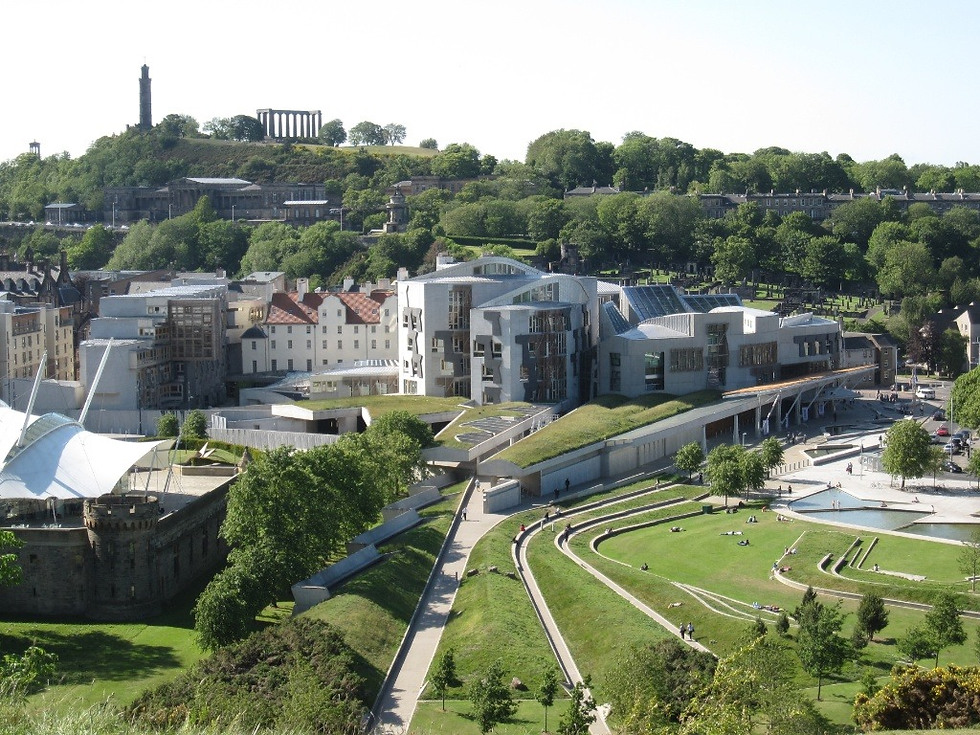
Here’s a counter example of more vernacular, respectful and historically aware architecture, that discards with material mismatch.

I appreciate this AI render is a bit wonky, but it demonstrates that classical architecture needn’t be stuffy or pastiche. There are still public spaces, green roofs, balconies, skylights, waterproofing, clean landscaping lines and more.
Conclusion
There are so many more points and ideas to cover. But such thought has to wrap up somewhere. There are ways to make our cities much more humane, green, fun and balanced. And such solutions don’t cost a lot in time, thought or effort (unlike redressing Holyrood.) It’s up to each person to shape their own corner of the world and to shape what is within their power. Then the effect will spread slowly but surely, bit by bit, drop by drop.


